When people talk about ministry and leadership in the churches Paul worked with, the discussion often becomes too simple. It is usually reduced to one question:
Did Paul allow women to minister?
This question expects a short answer: yes or no. But that approach misses the point. It forces a complex situation into neat boxes and ignores how early Christian communities really worked.
When we look more carefully at Paul’s letters, we see a much richer picture. The early Church was not tidy or uniform. Different communities faced different challenges, and Paul responded to real people in real situations.
Ministry and Leadership Are Not the Same
One important thing to understand is that ministry and leadership are not exactly the same.
In the New Testament, ministry means serving others. Paul believed that all Christians—men and women—were called to serve Christ and the community. He did not limit ministry to one gender.
Most debates are really about leadership, not ministry. The question is whether women led churches, not whether they served them.
Even then, many Bible passages used in this debate are not mainly about leadership roles. For example, passages in 1 Corinthians, Ephesians, and 1 Timothy deal with:
- behaviour in worship
- family relationships
- teaching and learning
- keeping peace and order
These texts respond to specific problems. They are not simple rule books. That is why quick answers do not work well.
Leadership in the First Churches
Leadership in the earliest churches took different forms. There was no single model.
Some leaders travelled from place to place to tell people about Jesus. These leaders included apostles and missionaries, like Paul himself. They helped start new churches and supported growing communities.
Other leaders stayed in one place. They looked after the daily life of the church. They taught, encouraged, and guided the community.
These roles often overlapped. A person could be a travelling leader at one time and a local leader at another. Leadership was flexible and shaped by the needs of the church.
Most recorded leaders were men, but Paul’s letters show clearly that some women were leaders as well.
Priscilla is often named with her husband Aquila. In many passages, her name comes first. This suggests that she played a leading role.
In the book of Acts, Priscilla helps teach Apollos, an educated teacher. This shows that she had knowledge, confidence, and authority. Priscilla and Aquila also hosted churches in their home, which made them important local leaders.
Phoebe was a respected leader in her church. Paul calls her a minister and also a patron, someone who supports others with her resources.
She likely carried Paul’s letter to the Romans. This was an important task. It meant she would have read the letter aloud and helped people understand it. Paul speaks very highly of her and trusts her role.
Junia is one of the most striking examples. Paul describes her as “well‑known among the apostles.” Strong evidence shows that Junia was a woman and that she was recognised as an apostle.
Later readers struggled with this idea and tried to explain it away. This shows how powerful assumptions can shape interpretation.
Other women—such as Lydia, Nympha, Chloe, Euodia, and Syntyche—also appear as hosts, co‑workers, and leaders. Paul says that Euodia and Syntyche worked hard alongside him in spreading the gospel.
All of this points to a mixed picture:
- Women took part in leadership and teaching
- At the same time, churches still reflected social rules about family and household order
The early Church held these things together, even when they were uncomfortable. It was not perfect or simple. It was learning as it grew.
Why This Still Matters
The early Church does not give us one clear answer for today. Instead, it reminds us to be careful and honest when we read Scripture.
Paul’s churches show us that leadership was diverse and shaped by mission, culture, and community needs. Women like Priscilla, Phoebe, and Junia were not side notes. They were central to the life of the Church.
Their stories remind us that Christian leadership has always been more complex—and more surprising—than we often expect.
***Based on the chapter “Apostles, Deacons, Patrons, Co-workers, and Heads of Household: Women Leaders in the Pauline Communities” by Paula Gooder in the 2013 book Biblical Interpretation and Method: Essays in Honour of John Barton, edited by Katharine J. Dell and Paul M. Joyce
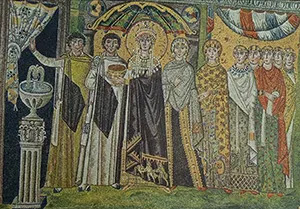
Image: Theodora holds the chalice. Altar apse mosaic, Basilica of San Vitale, Ravenna.
Source: Wilpert, Malereien, pl. 110